
How Tymira360 Helped a Clinical Psychologist Streamline Practice Operations

A growing private psychology practice was drowning in administrative work. Tymira360 centralized everything — and gave Dr. Sarah her clinical time back.
Overview
MindWell Psychological Services, a multidisciplinary group practice, struggled to maintain efficiency while scaling to a team of 12 clinicians. To resolve these operational bottlenecks, the practice implemented Tymira360, a robust mental health practice management software. This transition enabled the team to improve mental health care coordination and leverage specialized practice management software for psychologists to unify their fragmented workflows.

The Challenge
As the practice grew, it became clear that manual tracking and siloed systems were insufficient for a modern clinical environment. Without a centralized mental health practice management software, MindWell faced several critical operational risks.
Managing Multiple Providers
Coordinating schedules for 12 clinicians using spreadsheets was unsustainable. The lack of a dedicated practice management software for psychologists meant administrative staff spent hours resolving calendar conflicts instead of supporting client care.
Inconsistent Documentation
Each provider maintained records differently, creating significant hurdles for mental health care coordination when clients were referred internally between providers.
Collaboration Gaps
In a multidisciplinary setting, effective care requires a unified platform. Without one, communication between psychologists, psychiatrists, and social workers relied on insecure emails and phone calls, leading to potential gaps in treatment.
As the practice expanded, several challenges emerged.
Managing Multiple Providers
With clinicians operating different schedules, managing appointments and provider availability became increasingly complex.
Administrative staff spent significant time coordinating calendars, rescheduling sessions, and resolving scheduling conflicts.
Inconsistent Documentation
Each provider maintained records differently, making it difficult to maintain consistency across the organization.
This created challenges when clients were referred internally between providers.
Limited Visibility Across the Practice
Leadership lacked a centralized view of:
- Active clients
- Caseload distribution
- Appointment volumes
- Provider utilization
- Client retention
- Service demand
Without reliable data, strategic planning became difficult.
Collaboration Challenges
Many clients required support from multiple professionals.
For example:
- A psychologist conducting therapy
- A psychiatrist managing medication
- A social worker supporting family interventions
Without a unified platform, collaboration often relied on emails, phone calls, and manual record sharing.
Reporting and Operational Oversight
Generating reports required collecting information from multiple sources, making management oversight time-consuming and inefficient.
The Solution
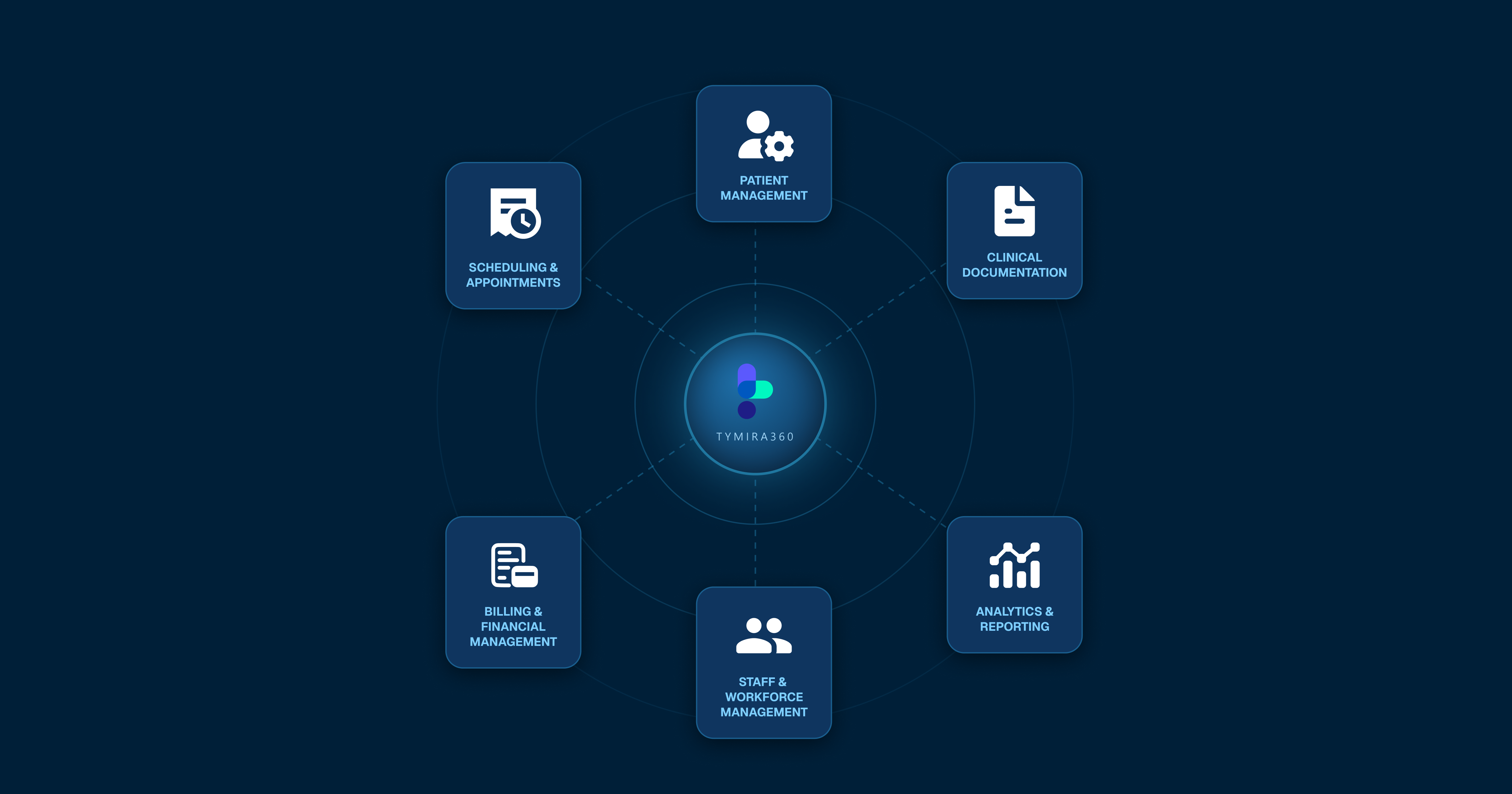
The organization implemented Tymira360 as its centralized Mental Health Practice Management and Electronic Health Records platform.
Unified Client Records
All client information was consolidated into a secure digital record, including:
- Intake forms
- Assessments
- Clinical notes
- Treatment plans
- Risk assessments
- Referrals
- Progress reviews
This provided a complete view of each client's journey.
Team-Based Care Management
Authorized providers could access relevant client information, improving communication and coordination between care teams.
This enabled smoother referrals and more integrated care delivery.
Centralized Scheduling
Tymira360 provided a shared scheduling system that allowed the organization to:
- Manage provider calendars
- Coordinate appointments
- Track availability
- Reduce scheduling conflicts
- Improve client follow-up management
Standardized Clinical Documentation
The practice adopted standardized templates for documentation, helping improve quality, consistency, and compliance across all providers.
Analytics and Reporting
Leadership gained access to real-time dashboards showing:
- Client activity
- Appointment trends
- Provider performance
- Service utilization
- Practice growth indicators
Results
Improved Care Coordination
Providers could access relevant information when needed, resulting in smoother collaboration and better continuity of care.
Increased Team Productivity
Administrative staff spent less time managing schedules and records, allowing them to focus on client support and operational improvement.
Better Client Experience
Clients benefited from:
- Faster service delivery
- Improved communication
- More coordinated care
- Better follow-up management
Greater Operational Visibility
Leadership gained access to actionable insights that supported planning, staffing decisions, and service expansion.
Consistent Clinical Standards
Standardized workflows improved documentation quality and supported a more uniform client experience across the practice.
Impact
By implementing Tymira360, MindWell Psychological Services successfully transitioned from fragmented systems to a unified digital platform.
The practice was able to improve operational efficiency, strengthen collaboration among providers, and create a scalable foundation for continued growth.
Most importantly, clinicians were able to spend more time supporting clients and less time managing administrative processes.

Looking Ahead
As mental health group practices continue to grow, the ability to coordinate care, manage teams, and monitor performance becomes increasingly important.
Tymira360 provides mental health organizations with the tools needed to manage multidisciplinary teams, streamline operations, improve care coordination, and scale services with confidence.
Whether a practice has five providers or fifty, Tymira360 helps create a connected environment where clinicians can focus on delivering exceptional mental health care while leadership gains the visibility needed to drive sustainable growth.

Tymira Health Point of View
Mental health providers should spend more time in care and less time chasing forms, schedules, balances, and reports. Tymira Health should protect clinical focus while making administration visible and manageable.
Implementation Playbook
Start with appointment flow, intake readiness, documentation status, payment visibility, and follow-up queues. These are the areas that most often pull clinicians away from care.
Use role-based access so clinical notes, finance tasks, and administrative reporting remain connected but not overexposed to the wrong users.
Metrics to Track
Track clinician documentation time, missed follow-ups, patient wait time, unpaid balances, appointment utilization, incomplete intake, and leadership reporting time.
People Also Ask: FAQs
Can practice management tools help clinicians directly? Yes, when they reduce repeated administrative work and make the next step easier to see.
Should mental health workflows be treated differently from general clinic workflows? Yes. Mental health requires extra care around privacy, consent, notes, risk, and continuity.
What is the first sign a practice has outgrown manual operations? Clinicians spend more time coordinating work than delivering care, and leaders cannot see the problem until it becomes urgent.
Sharp Conclusion
A mental health practice runs better when the system supports clinical care quietly, keeps administration organized, and gives leaders enough visibility to improve without interrupting providers.